 付款。
付款。(在家觀看 = 0%,在校觀看 = 100%)
100% 在校觀看日期及時間:
自由選擇,點選以下地區觀看辦公時間及位置

課時: 36 小時
享用時期: 18 星期。進度由您控制,可快可慢。
課堂錄影導師:Larry
在校免費試睇:首 3 小時,請致電以上地點與本中心職員預約。
本課程提供在校免費重睇及導師解答服務。
(在家觀看 = 100%,在校觀看 = 0%)
100% 在家觀看日期及時間:
每天 24 小時全天候不限次數地觀看
課時: 36 小時
享用時期: 18 星期。進度由您控制,可快可慢。
課堂錄影導師:Larry
在校免費試睇:首 3 小時,請致電以上地點與本中心職員預約。
本課程提供導師解答服務。
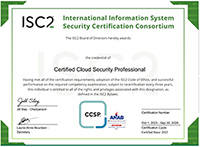
ISC2 創立了 Certified Cloud Security Professional (CCSP) 資格認證,以確保雲端安全專業人士在雲安全設計、實施、架構、運營、控制和遵守法規框架方面具備所需的知識、技能和能力。
CCSP 認證持有人必需在雲端環境中具備信息安全相關的專業知識,並展示在雲端安全架構、設計、營運和服務協調方面的能力。而 CCSP 認證本身亦獲得美國國家標準協會 (ANAB) 的 ISO 17024 認可,繼而成為全球認可的知識體系。
CCSP 知識體系 (Common Body of Knowledge) 包含的題材確保了其在雲端安全領域的所有技術範疇的相關性。
為成功通過考試及取得 CCSP 認證, 學員必須在以下 6 個領域展示相關的能力:
- Domain 1. Cloud Concepts, Architecture and Design
- Domain 2. Cloud Data Security
- Domain 3. Cloud Platform & Infrastructure Security
- Domain 4. Cloud Application Security
- Domain 5. Cloud Security Operations
- Domain 6. Legal, Risk and Compliance
備註:自 2016 年起 CCSP 認證已被納入香港金融管理局 (HKMA) 的 Enhanced Competency Framework on Cybersecurity (ECF-C) 專業級別認證, 並指示各金融機構 (如銀行、交易所等等) 的資訊科技安全相關人員務必持有 CCSP 認證。
資料來源:
https://www.hkma.gov.hk/media/eng/doc/key-information/guidelines-and-circular/2019/20190110e1.pdf (第4至第7頁)
若要考取 CCSP,同學須要:
- 具備 5 年資訊科技相關的工作經驗, 其中 3 年必須是在資訊安全領域,而 1 年必須在以上 CCSP 大綱的六個領域之一。
- 通過 CCSP 考試。(我們備有大量練習令學員更易通過考試)
- 通過 Endorsement 過程。(本中心的 CCSP 學員可向本中心免費申請 Endorsement 的協助,而本中心會按照 ISC2 指引來免費提供 Endorsement 服務)
- 通過 ISC2 的審核。
備註:申請者如未具有足夠的工作經驗,依然可以參加本課程及 CCSP 考試,考試後成為 Associate of ISC2,並於未來 6 年內累積足夠的工作經驗 (即上述的 1.) 時,便可以申請成為 CCSP。
| 課程名稱: |
Certified Cloud Security Professional (CCSP) 國際認可證書課程 - 簡稱:CCSP Training Course |
| 課程時數: | 合共 36 小時 (共 12 堂,共 1 科) |
| 適合人士: | 有志考取 Certified Cloud Security Professional 證書人士或對雲端保安技術有興趣人士 |
| 授課語言: | 以廣東話為主,輔以英語 |
| 課程筆記: | 本中心導師親自編寫英文為主筆記,而部份英文字附有中文對照。 |
| 1. 提供模擬考試題目: | 本中心為學員提供模擬考試題目,每條考試題目均附有標準答案。(我們備有大量練習令學員更易通過考試) |
| 2. 時數適中: | 本中心的 Certified Cloud Security Professional (CCSP) 國際認可證書課程時數適中,有 36小時。 令學員能真正了解及掌握課程內容,而又能於 3 個月內考獲以下 1 張國際認可證書:
|
| 3. 導師親自編寫筆記: | 資深導師 Larry Chan具備了 20 年以上電腦、網絡、數據庫及雲端保安系統的工作經驗,而最近 20 年更於本中心全職教學。 資深導師 Larry Chan並同時於本中心教授資訊科技安全及雲端安全相關的不同課程, 包括:
資深導師 Larry Chan 親自編寫筆記,絕對適合考試及實際管理之用,令你無須「死鋤」如字典般厚及不適合香港讀書格調的書本。 |
| 4. 一人一機上課: | 本課程以一人一機模式上課。 |
| 5. 免費重讀: | 傳統課堂學員可於課程結束後三個月內免費重看課堂錄影。 |
首先自行前往 ISC2 網站建立 ISC2 Account 並以該 ISC2 Account 登入,登入後依從該網站指示完善您的個人資料 (如姓名、電話號碼及電郵地址等等)。 重要:您必須按照在考試中心出示的身份證上的資料來填寫您的信息。如果不完全匹配,您將無法參加考試,且不會獲退還任何費用。 提交 ISC2 的網上電子表格後,您將被重定向到 Pearson VUE 網站,在那裏您將能夠親自選擇您應考的場地及時間,並繳付 USD$599 之考試費。 考試當日到達您選擇的應考場地時必須出示下列兩項有效之身份證明文件,否則考生不可進行考試,而已繳付之考試費亦不會退回:
考試題目將會傳送到你要應考的電腦,考試時以電腦作答。所有考試題目均為英文,而考試題目格式為單項及多項選擇題。 考試不合格便可於 30 日後重新報考,每年最多 4 次。欲知道作答時間、題目總數、合格分數等詳細考試資料,可瀏覽本中心網頁 "各科考試分數資料"。 以上內容只供參考,您於 Pearson VUE 網站成功預約應考場地及時間後將會收到來自官方的通知電郵,請您務必詳細閱讀該電郵內的應試細則。 |
| 課程名稱:Certified Cloud Security Professional (CCSP) 國際認可證書課程 - 簡稱:CCSP Training Course |
1. Cloud Architectural Concepts
1.1 CCSP Certification Introduction
1.2 Cloud Characteristics
1.2.1 Business Requirements
1.2.2 Existing State
1.2.3 Quantifying Benefits and Opportunity Cost
1.2.4 Intended Impact
1.3 Cloud Evolution, Vernacular, and Models
1.3.1 New Technology, New Options
1.3.2 Cloud Computing Service Models
1.3.3 Cloud Deployment Models
1.4 Cloud Computing Roles and Responsibilities
1.5 Cloud Computing Definitions
1.6 Foundational Concepts of Cloud Computing
1.6.1 Auditing and Compliance
1.6.2 Cloud Service Provider Contracts
1.7 Related and Emerging Technologies
1.8 CCSP CBK Domain converage
2. Design Requirements
2.1 Business Requirements Analysis
2.1.1 Inventory of Assets
2.1.2 Valuation of Assets
2.1.3 Determination of Criticality
2.1.4 Quantitative and Qualitative Risk Assessments
2.1.5 Risk Appetite
2.2 Security Considerations for Different Cloud Categories
2.2.1 IaaS Considerations
2.2.2 PaaS Considerations
2.2.3 SaaS Considerations
2.2.4 General Considerations
2.3 Design Principles for Protecting Sensitive Data
2.3.1 Hardening Devices
2.3.2 Encryption
2.4 Layered Defense and Defense In Depth
2.4.1 A Changing Work Environment and Threat Landscape
2.4.2 Defense in Depth is Similar To Physical Security
2.4.3 Common Cybersecurity Issues
2.4.4 The Different Elements of a Defense-in-Depth System
2.4.5 How Does Defense in Depth Help?
2.4.6 What is Layered Security and How Does it Relate To Defense in Depth?
2.4.7 What Are the Essentials Layers in a Defense-in-Depth Mechanism?
2.5 CCSP CBK Domain converage
3. Data Classification
3.1 Data Inventory and Discovery
3.1.1 Data Ownership
3.1.2 The Data Lifecycle
3.1.3 Data Categorization
3.1.4 Data Classification
3.1.5 Data Mapping
3.1.6 Data Labeling
3.2 Data Discovery Methods
3.2.1 Label-Based Discovery
3.2.2 Metadata-Based Discovery
3.2.3 Content-Based Discovery
3.2.4 Data Analytics
3.2.5 Structured vs. Unstructured Data
3.3 Jurisdictional Requirements
3.4 Information Rights Management (IRM)
3.4.1 Intellectual Property Protections
3.4.2 Copyright
3.4.3 Trademarks
3.4.4 Patents
3.4.5 Trade Secrets
3.4.6 IRM Tool Traits
3.5 Data Control
3.5.1 Data Retention
3.5.2 Legal Hold
3.5.3 Data Audit
3.5.4 Data Destruction/Disposal
3.6 CCSP CBK Domain converage
4. Cloud Data Security
4.1 Cloud Data Lifecycle
4.1.1 Create
4.1.2 Store
4.1.3 Use
4.1.4 Share
4.1.5 Archive
4.1.6 Destroy
4.2 Cloud Storage Architectures
4.2.1 Volume Storage: File-Based Storage and Block Storage
4.2.2 Object-Based Storage
4.2.3 Databases
4.2.4 Content Delivery Network (CDN)
4.3 Cloud Data Security Foundational Strategies
4.3.1 Encryption
4.3.2 Key Management
4.4 Masking, Obfuscation, Anonymization, and Tokenization
4.5 Security Information and Event Management (SIEM)
4.6 Egress Monitoring (DLP)
4.7 Summary of Cloud Data Security
4.8 CCSP CBK Domain converage
5. Security in the Cloud
5.1 Shared Cloud Platform Risks and Responsibilities
5.2 Cloud Computing Risks by Deployment Model
5.2.1 Private Cloud Computing Risks
5.2.2 Community Cloud Computing Risks
5.2.3 Public Cloud Computing Risks
5.2.4 Vendor Lock-In
5.2.5 Vendor Lock-Out
5.2.6 Risks related to Multitenant Environments
5.2.7 The Brewer-Nash Model
5.2.8 Hybrid Cloud
5.3 Cloud Computing Risks by Service Model
5.3.1 Infrastructure as a Service (IaaS) Risks
5.3.2 Platform as a Service (PaaS) Risks
5.3.3 Software as a Service (SaaS) Risks
5.4 Virtualization
5.4.1 Virtualization Threats
5.4.2 Countermeasure Methodology
5.5 Disaster Recovery (DR) and Business Continuity (BC)
5.5.1 Cloud-Specific BIA Concerns
5.5.2 Customer/Provider Shared BC/DR Responsibilities
5.5.3 Logical Location of Backup Data/Systems
5.5.4 Declaration
5.5.5 Testing
5.6 Summary of Security in the Cloud
5.7 CCSP CBK Domain converage
6. Responsibilities in the Cloud
6.1 Foundations of Managed Services
6.2 Business Requirements
6.2.1 Business Requirements: The Cloud Provider Perspective
6.2.2 Cloud Provider Responsibilities: The Physical Plant
6.2.3 Cloud Provider Responsibilities: Secure Logical Framework
6.2.4 Cloud Provider Responsibilities: Secure Networking
6.2.5 Cloud Provider Responsibilities: Mapping and Selection of Controls
6.2.6 Shared Responsibilities by Service Type
6.3 Shared Administration of OS, Middleware, or Applications
6.4 Operating System Baseline Configuration and Management
6.5 Shared Responsibilities: Data Access
6.5.1 Customer Directly Administers Access
6.5.2 Provider Administers Access on Behalf of the Customer
6.5.3 Third-Party (CASB) Administers Access on Behalf of the Customer
6.6 Lack of Physical Access
6.6.1 Audits
6.6.2 SOC 1
6.6.3 SOC 2
6.6.4 Shared Policy
6.6.5 Shared Monitoring and Testing
6.7 Summary of Responsibilities in the Cloud
6.8 CCSP CBK Domain converage
7. Cloud Application Security
7.1 Training and Awareness
7.1.1 The CSA's Treacherous 12
7.1.2 Common Cloud Application Deployment Pitfalls
7.2 Cloud-Secure Software Development Lifecycle (SDLC)
7.2.1 Configuration Management for the SDLC
7.3 ISO/IEC 27034-1 Standards for Secure Application Development
7.3.1 ONF /ANF Example
7.4 Identity and Access Management (IAM)
7.4.1 Identity Repositories and Directory Services
7.4.2 Single Sign-On (SSO)
7.4.3 Federated Identity Management
7.4.4 Federation Standards
7.4.5 Multifactor Authentication
7.4.6 Supplemental Security Components
7.5 Cloud Application Architecture
7.5.1 Application Programming Interfaces
7.5.2 Tenancy Separation
7.5.3 Cryptography
7.5.4 Sandboxing
7.5.5 Application Virtualization
7.6 Cloud Application Assurance and Validation
7.6.1 Threat Modeling
7.6.2 STRIDE Mitigations to Web Application Security
7.6.3 Quality of Service
7.6.4 Software Security Testing
7.6.5 Approved APIs
7.6.6 Software Supply Chain (API) Management
7.6.7 Securing Open-Source Software
7.6.8 Application Orchestration
7.6.9 The Secure Network Environment
7.7 Summary of Cloud Application Security
7.8 CCSP CBK Domain converage
8. Operations Elements
8.1 Physical/Logical Operations
8.1.1 Facilities and Redundancy
8.1.2 American Society of Heating, Refrigerating and Air-Conditioning Engineers (ASHRAE)
8.1.3 Power Redundancy
8.1.4 Power Provider Redundancy
8.1.5 Power Line Redundancy
8.1.6 Power Conditioning and Distribution Redundancy
8.1.7 Communications Redundancy
8.1.8 Personnel Redundancy
8.1.9 Security Redundancy
8.1.10 Holistic Redundancy: The Uptime Institute Tiers
8.1.11 Virtualization Operations
8.1.12 Instance Isolation
8.1.13 Storage Operations
8.1.14 Physical and Logical Isolation
8.1.15 Application Testing Methods
8.2 Security Operations Center
8.2.1 Continuous Monitoring
8.2.2 Incident Management
8.3 Summary of Operations Elements
8.4 CCSP CBK Domain converage
9. Operations Management
9.1 Monitoring, Capacity, and Maintenance
9.1.1 Monitoring
9.1.2 Maintenance
9.1.3 Updates
9.2 Change and Configuration Management (CM)
9.2.1 Baselines
9.2.2 Deviations and Exceptions
9.2.3 Roles and Process
9.2.4 Release Management
9.3 IT Service Management and Continual Service Improvement
9.4 Business Continuity and Disaster Recovery (BC/DR)
9.4.1 Primary Focus
9.4.2 Continuity of Operations
9.4.3 The BC/DR Plan
9.4.4 The BC/DR Kit
9.4.5 Relocation
9.4.6 BC /DR Terminology
9.4.7 Power
9.4.8 Testing
9.5 Summary of Operations Management
9.6 CCSP CBK Domain converage
10. Legal and Compliance
10.1 Legal Requirements and Unique Risks in the Cloud Environment
10.1.1 Legal Concepts
10.1.2 US Laws
10.1.3 International Laws
10.1.4 Laws, Frameworks, and Standards Around the World
10.1.5 EU General Data Protection Regulation
10.1.6 Australian Privacy Act of 1988
10.1.7 Canada’s Personal Information Protection and Electronic Documents Act (PIPEDA)
10.1.8 Argentina’s Personal Data Protection Act
10.1.9 The EFTA and Switzerland
10.1.10 Asia-Pacific Economic Cooperation (APEC) Privacy Framework
10.2 Information Security Management Systems (ISMSs)
10.2.1 The Difference between Laws, Regulations, and Standards
10.3 Potential Personal and Data Privacy Issues in the Cloud Environment
10.3.1 eDiscovery
10.3.2 Chain of Custody and Nonrepudiation
10.3.3 Forensic Requirements
10.3.4 Conflicting International Legislation
10.3.5 Cloud Forensic Challenges
10.3.6 Direct and Indirect Identifiers
10.3.7 Forensic Data Collection Methodologies
10.4 Audit Processes, Methodologies, and Cloud Adaptations
10.4.1 Virtualization
10.4.2 Scope
10.4.3 Gap Analysis
10.4.4 Restrictions of Audit Scope Statements
10.4.5 Policies
10.4.6 Different Types of Audit Reports
10.4.7 Auditor Independence
10.4.8 AICPA Reports and Standards
10.5 The Impact of Diverse Geographical Locations and Legal Jurisdictions
10.5.1 Policies
10.5.2 Implications of the Cloud for Enterprise Risk Management
10.5.3 Choices Involved in Managing Risk
10.5.4 Risk Management Frameworks
10.5.5 Risk Management Metrics
10.5.6 Contracts and Service-Level Agreements (SLAs)
10.6 Business Requirements
10.7 Cloud Contract Design and Management for Outsourcing
10.8 Identifying Appropriate Supply Chain and Vendor Management Processes
10.8.1 Common Criteria Assurance Framework (ISO/IEC 15408-1:2022)
10.8.2 CSA Security, Trust, and Assurance Registry (STAR)
10.8.3 Supply Chain Risk
10.8.4 Manage Communication with Relevant Parties
10.9 Summary of Legal and Compliance