只有我們夠膽提供:本課程提供合格保障!
自 2023 年起,凡透過合格保障參加考試的同學,皆於首次應考便能通過考試。 |
傳統服務:課程上堂時間表 (地點:旺角 總費用:$2,680) 學員使用 WhatsApp、電話或本網頁報名,待本中心確認已為學員留位後,即可使用  繳付學費,過程簡便! 繳付學費,過程簡便!
|
超震撼: |
凡於 2026年 10月 2日 (五) 或之前報讀本課程,
原價 $3,350,現只需
$2,680! |
|
* 各政府部門可使用 P Card 付款
如使用 P Card 繳付考試費,考試費需另加 2.5% 行政費
# 請注意:ITIL® 官方授權機構硬性規定,報讀 ITIL® 課程時必須同時繳交相應的考試費
費用 ($2,680 + $4,108) 已經包括考試所需的費用
*** 質素保證:
免費於任何地點試睇首 1 小時課堂錄影,從而可預先了解導師及教材的質素,才報讀課程來上堂。***
請致電與本中心職員預約。
查看各地點電話
| 旺角 |
2332-6544 |
| 觀塘 |
3563-8425 |
| 沙田 |
2151-9360 |
| 在校免費補堂: |
學員可於任何校舍補看課堂錄影,從而可銜接往後的課堂!
|
| 在校免費重讀: |
學員可於課程結束後三個月內於任何校舍不限次數地重看課堂錄影,從而可反覆重溫整個課程! |
| 合格保障: |
半費重考。最後 1 堂之 1 個月內為保障期限。請務必向本中心購買考試券。 |
| 課時: |
18 小時 |
| 課堂導師: |
Franco (任教課程清單) |
|
推介服務:課堂錄影隨時睇 (在家觀看 = 0%,在校觀看 = 100%) 學員使用 WhatsApp、電話或本網頁報名,待本中心確認已為學員留位後,即可使用 繳付學費,過程簡便!
* 各政府部門可使用 P Card 付款
如使用 P Card 繳付考試費,考試費需另加 2.5% 行政費
# 請注意:ITIL® 官方授權機構硬性規定,報讀 ITIL® 課程時必須同時繳交相應的考試費
費用 ($2,412 / $2,546 / $2,680 + $4,108) 已經包括考試所需的費用
推介服務:課堂錄影隨時睇 (在家觀看 = 100%,在校觀看 = 0%) 學員使用 WhatsApp、電話或本網頁報名,待本中心確認已為學員留位後,即可使用 繳付學費,過程簡便!
* 各政府部門可使用 P Card 付款
如使用 P Card 繳付考試費,考試費需另加 2.5% 行政費
# 請注意:ITIL® 官方授權機構硬性規定,報讀 ITIL® 課程時必須同時繳交相應的考試費
費用 ($2,680 + $4,108) 已經包括考試所需的費用
注意! 客戶必須查問報讀學校的教育局註冊編號,以確認該校為註冊學校,以免蒙受不必要的損失!
只有我們夠膽提供:本課程提供合格保障!
自 2023 年起,凡透過合格保障參加考試的同學,皆於首次應考便能通過考試。 |
|
ITIL® 是管理基於技術的服務並為持份者創造價值的廣泛採用的框架。ITIL® 已從 IT 服務管理發展成為數位產品與服務管理的最佳實踐架構。
以下是 ITIL® 的 Certification Scheme
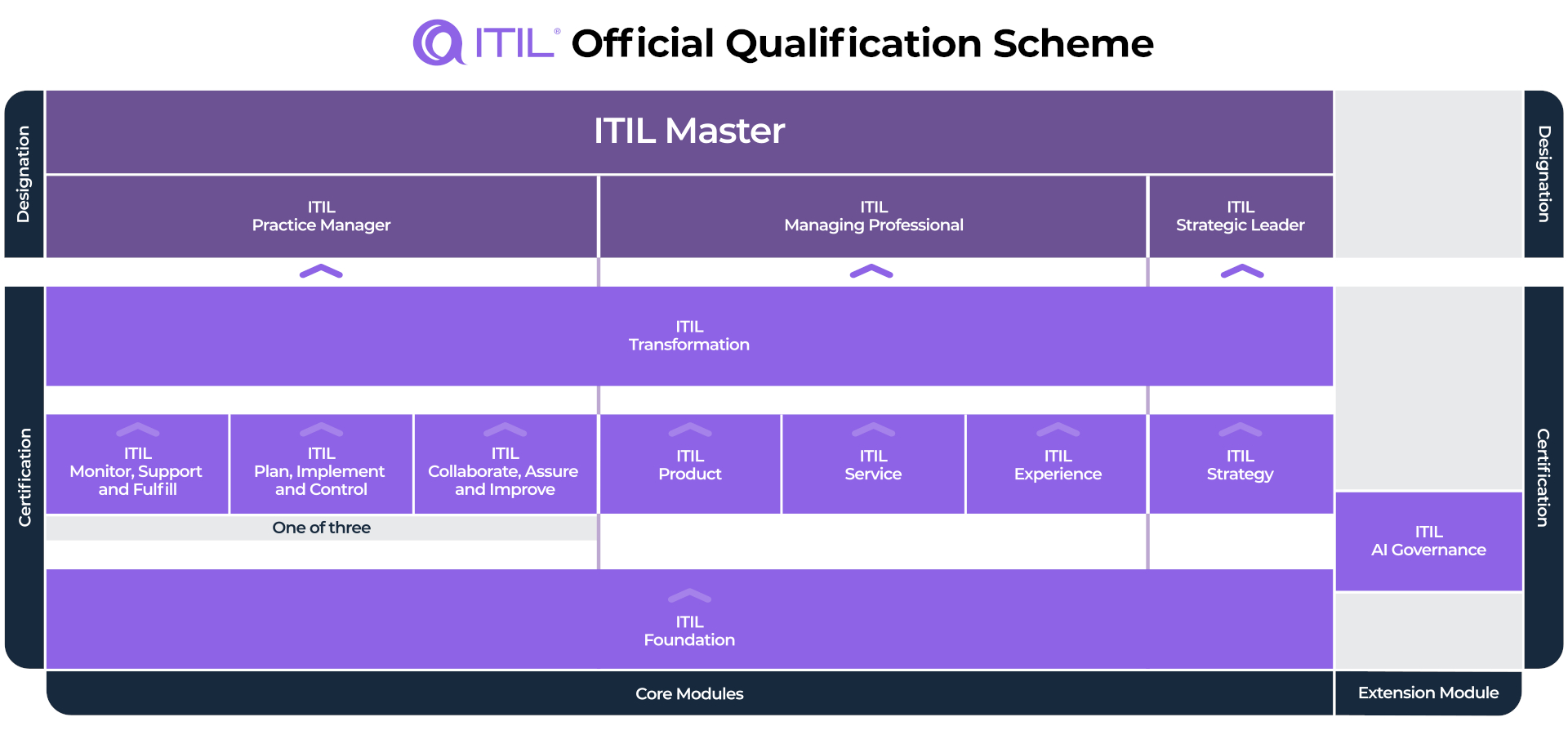
本中心的 ITIL® Foundation (Version 5) 國際認可證書課程是由教授 ITIL® 課程多年的導師 Franco 配合針對考試要求的教材授課,課程內容覆蓋 ITIL® Foundation (Version 5) syllabus 所要求的內容,針對考試重點授課,使同學能通過考試。 |
|
| 課程名稱: |
ITIL® Foundation (Version 5) 國際認可證書課程
- 簡稱:ITIL (Version 5) Training Course |
| 課程時數: |
共 18 小時課堂 (共 6
堂) |
| 適合人士: |
對 ITIL® 有興趣的人士 |
| 授課語言: |
以廣東話為主,輔以英語 |
| 課程筆記: |
本中心導師親自編寫英文為主筆記,而部份英文字附有中文對照。 |
只有我們夠膽提供:本課程提供合格保障!
自 2023 年起,凡透過合格保障參加考試的同學,皆於首次應考便能通過考試。 |
| 1. ITIL® 認可導師: |
專業ITIL® 認可導師教授。 |
| 2. 提供模擬考試題目: |
本中心為學員提供約 100 條 ITIL® Foundation 的模擬考試題目,每條考試題目均附有標準答案。 |
| 3. 考試合格保障: |
本中心 ITIL® Foundation 學員於第一次考 ITIL® Foundation 若不合格,可申請
半費重考 ITIL® Foundation 一次,但必須符合下列的四項要求:
1. 課堂出席率須達85%或以上。
2. 學員必須透過本中心安排及於本中心應考 ITIL® Foundation 考試。
3. 學員於第一次應考 ITIL® Foundation 考試前,必須進行本中心的 ITIL® Foundation 試前測驗,並取得90%或以上的分數。
4. 於上課結束日之一個月內作出申請。 |
| 4. 免費重讀: |
傳統課堂學員可於課程結束後三個月內免費重看課堂錄影。 |
只有我們夠膽提供:本課程提供合格保障!
自 2023 年起,凡透過合格保障參加考試的同學,皆於首次應考便能通過考試。 |
學員可以選擇在本中心或在家應考 ITIL® Foundation 考試。
選擇本中心考試的學員,請學員必須聯絡本中心職員以作安排。
- 電話:2332-6544
- 辦公時間:一至五:14:30 - 22:15;六:13:45 - 21:30 及日:10:15 - 18:00 (公眾假期休息)
|
Systematic |
星期一至五 |
星期六 |
星期日 |
公眾假期 |
旺角 |
14:45 - 22:15 |
14:00 - 21:30 |
10:30 - 18:00 |
休息 |
|
|
選擇在家考試的學員,學員需要自行準備電腦考試,而考試環境和電腦需要符合以下的要求。
考試環境要求:
- There is only one doorway for access in and out of the room.
- The room is private, and you can be sure you will be alone for the entire exam.
- The walls and desk/table(s) are clear of all unnecessary and/or unauthorized items (e.g., posters, post-it notes, papers and books).
- Where note paper or other resources are allowed, you can and should have this available on your desk for your exam onboarding. You must show these authorized items to the Proctor on request, so they can ensure there is nothing on them that could provide an unfair advantage.
- No screens are visible, other than the screen which is being used to take the exam.
- There is adequate light to ensure the Proctor can see you clearly throughout the exam. Light should not be directed toward the webcam.
考試電腦要求:
- Windows® 11, Windows® 10 version 17763 or later (Windows 10S is not supported), Windows® 8.1, Windows® 8.
- Internet Explorer version 10 or greater.
- Dual-core 2.4GHz CPU or faster with 2GB of RAM (Minimum requirements).
- Active Full-Time/Broadband internet connection of at least 4Mbps.
- 16-bit monitor (at least 15") with screen resolution 1024 x 768 or higher.
- Speakers and microphone.
- Keyboard and mouse or another pointing device (keyboard set to English characters).
- A single web camera you can rotate.
- Cameras are clear and free from obstruction.
- You can rotate your webcam 360 degrees, low and high, to show all areas of the room, including under the desk, the desk surface and any other areas that may pose a risk to exam security.
- The computer sound settings are set to Speakers and Microphones. Headsets are not allowed during the exam.
- The screen and webcam are positioned so that you and the doorway of the room are fully visible to the Proctor through the webcam.
- You are sat comfortably and can maintain the same position, in full view of the Proctor, throughout the exam.
我們會安排同學在本中心應考 ITIL® Foundation 考試。考試費為 HK$4,108。
* 我們會在約 3 月中開始向同學提供 ITIL® Foundation 考試服務 |
只有我們夠膽提供:本課程提供合格保障!
自 2023 年起,凡透過合格保障參加考試的同學,皆於首次應考便能通過考試。 |
課程名稱:ITIL® Foundation (Version 5) 國際認可證書課程
- 簡稱:ITIL (Version 5) Training Course |
1 Key ITIL terms and definitions [Syllabus Reference: 1]
1.1 Product and service management [Syllabus Reference: 1.1]
1.1.1 Define digital product and service management [Syllabus Reference: 1.1.1]
1.1.2 Define product, service as a key concept of digital product and service management [Syllabus Reference: 1.1.2]
1.1.3 Define digital product, digital service as a key concept digital product and service management [Syllabus Reference: 1.1.3]
1.1.4 Define continual improvement as a key concept of digital product and service management [Syllabus Reference: 1.1.4]
1.1.5 Define the ITIL Product and Service Lifecycle as a key concept of digital product and service management [Syllabus Reference: 1.1.5]
1.1.6 Define good as a key concept of digital product and service management [Syllabus Reference: 1.1.6]
1.1.7 Define utility, warranty, user experience and sustainability [Syllabus Reference: 1.1.7]
1.1.8 Know the benefits of ITIL for enterprises, managed service providers, digital product vendors, digital product and service management professionals [Syllabus Reference: 1.1.8]
1.2 Experience, Strategy and Transformation [Syllabus Reference: 1.2]
1.2.1 Define basic terms of ITIL Experience like: experience, digital experience, trust, user experience (UX), customer experience (CX), experience level agreement, human-centred design
1.2.2 Define basic terms of ITIL Strategy like: strategy, business strategy, digital strategy, mission, vision, purpose, VUCA, leadership [Syllabus Reference: 1.2.2]
1.2.3 Define basic terms of ITIL Transformation like: change, transformation, business as usual (BAU) [Syllabus Reference: 1.2.3]
1.3 Service offerings [Syllabus Reference: 1.3]
1.3.1 Define and explain service offering and service interactions [Syllabus Reference: 1.3.1 & 1.3.3]
1.3.2 Define and explain service actions, transfer of goods, access to resources [Syllabus Reference: 1.3.2 & 1.3.4]
1.4 Value co-creation [Syllabus Reference: 1.4]
1.4.1 Define value, value co-creation, cost, risk, output, and outcome [Syllabus Reference: 1.4.1 - 1.4.3]
1.4.2 Understand the difference between output and outcome [Syllabus Reference: 1.4.4]
1.4.3 Explain how value contributes to value co-creation [Syllabus Reference: 1.4.5]
1.4.4 Explain how outcomes, costs, risks contribute to value co-creation [Syllabus Reference: 1.4.6]
1.4.5 Explain how utility, warranty, user experience, sustainability contribute to value co-creation [Syllabus Reference: 1.4.7]
1.4.6 Explain how feedback contributes to value co-creation [Syllabus Reference: 1.4.8]
1.5 Service relationships [Syllabus Reference: 1.5]
1.5.1 Define organization, service provider, service consumer, digital product vendor as key concepts of service relationships [Syllabus Reference: 1.5.1]
1.5.2 Define relationship types (basic, cooperative, collaborative) and the service journey [Syllabus Reference: 1.5.2]
1.5.3 Define the service journey as a key concept of service relationships [Syllabus Reference: 1.5.3]
1.5.4 Define sponsor, customer, and user roles as key concepts of service relationships [Syllabus Reference: 1.5.4]
1.5.5 Define service quality, service level as key concepts of service relationship [Syllabus Reference: 1.5.5]
1.5.6 Define SLA as key concepts of service relationship [Syllabus Reference: 1.5.6]
1.5.7 Understand the difference between service provider and service consumer [Syllabus Reference: 1.5.7]
1.5.8 Understand the difference between service provider and digital product vendor [Syllabus Reference: 1.5.8]
1.5.9 Understand the difference between service consumer and digital product vendor [Syllabus Reference: 1.5.9]
1.5.10 Understand the difference between basic, cooperative, and collaborative service relationships [Syllabus Reference: 1.5.10]
2 The ITIL Four Dimensions of Product and Service Management [Syllabus Reference: 2]
2.1 Introduction to the Four Dimensions [Syllabus Reference: 2.1]
2.1.1 List the ITIL Four Dimensions of Product and Service Management: organizations and people, partners and suppliers, information and technology, value streams and processes [Syllabus Reference: 2.1.1]
2.1.2 Understand the importance of each of the ITIL Four Dimensions of Product and Service Management [Syllabus Reference: 2.1.2]
2.1.3 Explain the importance of the holistic approach of the ITIL Four Dimensions of Product and Service Management [Syllabus Reference: 2.1.3]
2.2 Internal factors and External factors [Syllabus Reference: 2.2]
2.2.1 Know the external factors that influence the ITIL Four Dimensions of Product and Service Management, like: political, economical, social, technology, legal, environmental (PESTLE) [Syllabus Reference: 2.2.1]
2.2.2 Explain 'organizations and people', 'partners and suppliers', 'information and technology', 'value streams and processes' as the ITIL Four Dimensions of Product and Service Management [Syllabus Reference: 2.2.2]
2.2.2.1 Organizations and people
2.2.2.2 Information and technology
2.2.2.3 Partners and suppliers
2.2.2.4 Value streams and processes
3 The ITIL Product and Service Lifecycle [Syllabus Reference: 3]
3.1 Introduction to ITIL Product and Service Lifecycle [Syllabus Reference: 3.1]
3.1.1 List the ITIL Product and Service Lifecycle activities: discover, design, acquire, build, transition, operate, deliver, support [Syllabus Reference: 3.1.1]
3.1.2 Understand the ITIL Product and Service Lifecycle [Syllabus Reference: 3.1.2]
3.1.3 Understand that the activities of the ITIL Product and Service Lifecycle are not sequential nor linear and how they can be used iteratively [Syllabus Reference: 3.1.3]
3.2 Purpose and Scope of ITIL Product and Service Lifecycle activities [Syllabus Reference: 3.2]
3.2.1 Know the purpose of the 'discover' ITIL Product and Service Lifecycle activity [Syllabus Reference: 3.2.1]
3.2.2 Know the purpose of the 'design' ITIL Product and Service Lifecycle activity [Syllabus Reference: 3.2.2]
3.2.3 Know the purpose of the 'acquire' ITIL Product and Service Lifecycle activity [Syllabus Reference: 3.2.3]
3.2.4 Know the purpose of the 'build' ITIL Product and Service Lifecycle activity [Syllabus Reference: 3.2.4]
3.2.5 Know the purpose of the 'transition' ITIL Product and Service Lifecycle activity [Syllabus Reference: 3.2.5]
3.2.6 Know the purpose of the 'operate' ITIL Product and Service Lifecycle activity [Syllabus Reference: 3.2.6]
3.2.7 Know the purpose of the 'deliver' ITIL Product and Service Lifecycle activity [Syllabus Reference: 3.2.7]
3.2.8 Know the purpose of the 'support' ITIL Product and Service Lifecycle activity [Syllabus Reference: 3.2.8]
4 The ITIL Value System [Syllabus Reference: 4]
4.1 Components of the ITIL Value System [Syllabus Reference: 4.1]
4.1.1 Know the components of the ITIL Value System and their role in an organization: Guiding principles, Governance, Value chain, Management practices, Continual improvement [Syllabus Reference: 4.1.1]
4.1.2 Explain the ITIL Value System (ITIL VS) and its purpose [Syllabus Reference: 4.1.2]
4.2 The ITIL Guiding Principles [Syllabus Reference: 4.2]
4.2.1 List the ITIL Guiding Principles [Syllabus Reference: 4.2.1]
4.2.2 Understand the 'focus on value' ITIL Guiding Principle and how it should be used [Syllabus Reference: 4.2.2]
4.2.3 Understand the 'start where you are' ITIL Guiding Principle and how it should be used [Syllabus Reference: 4.2.3]
4.2.4 Understand the 'progress iteratively with feedback' ITIL Guiding Principle and how it should be used [Syllabus Reference: 4.2.4]
4.2.5 Understand the 'collaborate and promote visibility' ITIL Guiding Principle and how it should be used [Syllabus Reference: 4.2.5]
4.2.6 Understand the 'think and work holistically' ITIL Guiding Principle and how it should be used [Syllabus Reference: 4.2.6]
4.2.7 Understand the 'keep it simple and practical' ITIL Guiding Principle and how it should be used [Syllabus Reference: 4.2.7]
4.2.8 Understand the 'optimize and automate' ITIL Guiding Principle and how it should be used [Syllabus Reference: 4.2.8]
4.2.9 Describe the interaction of the ITIL Guiding Principles and how they work together [Syllabus Reference: 4.2.9]
4.3 Governance [Syllabus Reference: 4.3]
4.3.1 Define governance [Syllabus Reference: 4.3.1]
4.3.2 Explain the enabling nature and the activities of governance [Syllabus Reference: 4.3.2]
4.4 Value chain [Syllabus Reference: 4.4]
4.4.1 Define value chain [Syllabus Reference: 4.4.1]
4.4.2 Define product specification, product prototype [Syllabus Reference: 4.4.2]
4.4.3 Define incident, event [Syllabus Reference: 4.4.3]
4.4.4 Define release, test [Syllabus Reference: 4.4.4]
4.4.5 Define continuous integration, continuous delivery and continuous deployment [Syllabus Reference: 4.4.5]
4.4.6 Define reliability, Site Reliability Engineering (SRE), observability [Syllabus Reference: 4.4.6]
4.4.7 Define service request [Syllabus Reference: 4.4.7]
4.4.8 Define disaster, problem, error, and known error [Syllabus Reference: 4.4.8]
4.4.9 Define operating model [Syllabus Reference: 4.4.9]
4.4.10 Distinguish between problem, error, and known error [Syllabus Reference: 4.4.10]
4.4.11 Understand the key success metrics of the value chain activities [Syllabus Reference: 4.4.11]
4.4.12 Explain how organization’s purpose and operating model are supported by value chain activities and management practices [Syllabus Reference: 4.4.12]
4.5 Management practices [Syllabus Reference: 4.5]
4.5.1 Define management practices [Syllabus Reference: 4.5.1]
4.5.2 Know the management practice groups: general and product and service management practices [Syllabus Reference: 4.5.2]
4.5.3 Understand the role of the management practices within the ITIL Value System [Syllabus Reference: 4.5.3]
4.5.4 Explain the structure of the ITIL Practice Guides [Syllabus Reference: 4.5.4]
4.5.5 Explain the benefits of the ITIL Practice Guides [Syllabus Reference: 4.5.5]
4.5.6 Define metric and critical success factor (CSF) [Syllabus Reference: 4.5.6]
4.6 The ITIL Continual Improvement Model [Syllabus Reference: 4.6]
4.6.1 List the steps of the ITIL Continual Improvement Model [Syllabus Reference: 4.6.1]
4.6.2 Understand the steps of the ITIL Continual Improvement Model [Syllabus Reference: 4.6.2]
4.6.2.1 What is the vision?
4.6.2.2 Where are we now?
4.6.2.3 Where do we want to be?
4.6.2.4 How do we get there?
4.6.2.5 Take action
4.6.2.6 Are we getting there?
4.6.2.7 How do we keep the improvements relevant?
4.6.3 Describe continual improvement within the ITIL Value System and its role in the organization [Syllabus Reference: 4.6.3]
5 Value stream identification, mapping, and management [Syllabus Reference: 5]
5.1 Key concepts of value stream mapping and management [Syllabus Reference: 5.1]
5.1.1 Define value stream, core value stream, enabling value stream [Syllabus Reference: 5.1.1]
5.1.2 Understand the difference between a core and an enabling value stream [Syllabus Reference: 5.1.4]
5.1.3 Define value stream mapping, value stream management [Syllabus Reference: 5.1.2]
5.1.3.1 Value Stream Mapping
5.1.3.2 Value Stream Management
5.1.4 Define complexity thinking [Syllabus Reference: 5.1.3]
5.2 Application and optimization of workflows [Syllabus Reference: 5.2]
5.2.1 Understand how workflows need to be optimized for complexity [Syllabus Reference: 5.2.1]
5.3 Purpose and elements of value stream mapping [Syllabus Reference: 5.3]
5.3.1 Know the purpose of value stream mapping and management [Syllabus Reference: 5.3.1]
5.3.2 Understand the relationship between value stream mapping and value stream management [Syllabus Reference: 5.3.2]
5.3.3 Understand the elements of a value stream map [Syllabus Reference: 5.3.3]
6 ITIL and AI [Syllabus Reference: 6]
6.1 Introduction to AI [Syllabus Reference: 6.1]
6.1.1 Define Artificial Intelligence (AI), AI maturity, GenAI, Agentic AI [Syllabus Reference: 6.1.1]
6.1.2 Understand how AI can assist in the product and service development lifecycle and provide examples [Syllabus Reference: 6.1.2]
6.1.3 Understand how AI can be used to assist in the automation of processes throughout the product and service development lifecycle activities [Syllabus Reference: 6.1.3]
6.1.4 Understand how AI can be leveraged throughout the ITIL value chain activities [Syllabus Reference: 6.1.4]
6.2 ITIL AI Governance [Syllabus Reference: 6.2]
6.2.1 Define AI governance [Syllabus Reference: 6.2]
6.2.2 Understand the ITIL AI Capability Model [Syllabus Reference: 6.2]
8 ITIL and other frameworks [Syllabus Reference: 7]
8.1 ITIL and DevOps [Syllabus Reference: 7.1]
8.1.1 Understand how ITIL can collaborate with DevOps practices [Syllabus Reference: 7.1.1]
8.1.2 Understand how ITIL and DevOps are complementary in the product and service development lifecycle [Syllabus Reference: 7.1.2]
8.2 ITIL and PRINCE2 [Syllabus Reference: 7.2]
8.2.1 Understand why project management is important in ITIL [Syllabus Reference: 7.2.1]
8.2.2 Understand how ITIL and PRINCE2 are complementary in the product and service development lifecycle [Syllabus Reference: 7.2.2]
|
|